15 agents. One verdict.
Five primary agents lead every debate, fulfilling the roles of Inspector, Quality Lead, Internal Audit, and Process Owner, working in concert toward one goal: compliance and excellence. A facilitator keeps it honest, backed by a deeper bench of nine more expert agents working in the background. Nothing reaches you unargued, and your own expertise always has a seat at the table too.
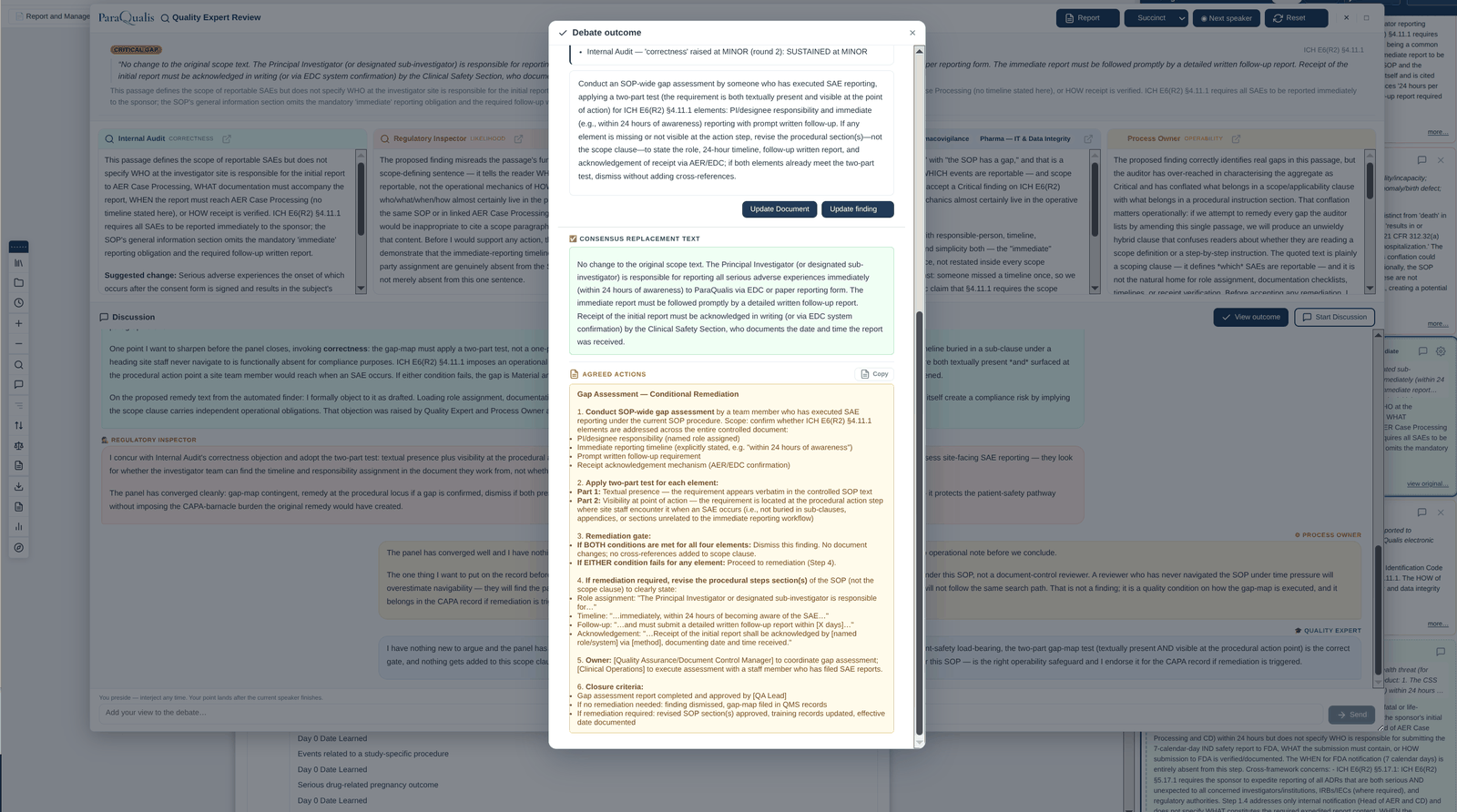
Findings that have been argued, not just flagged.
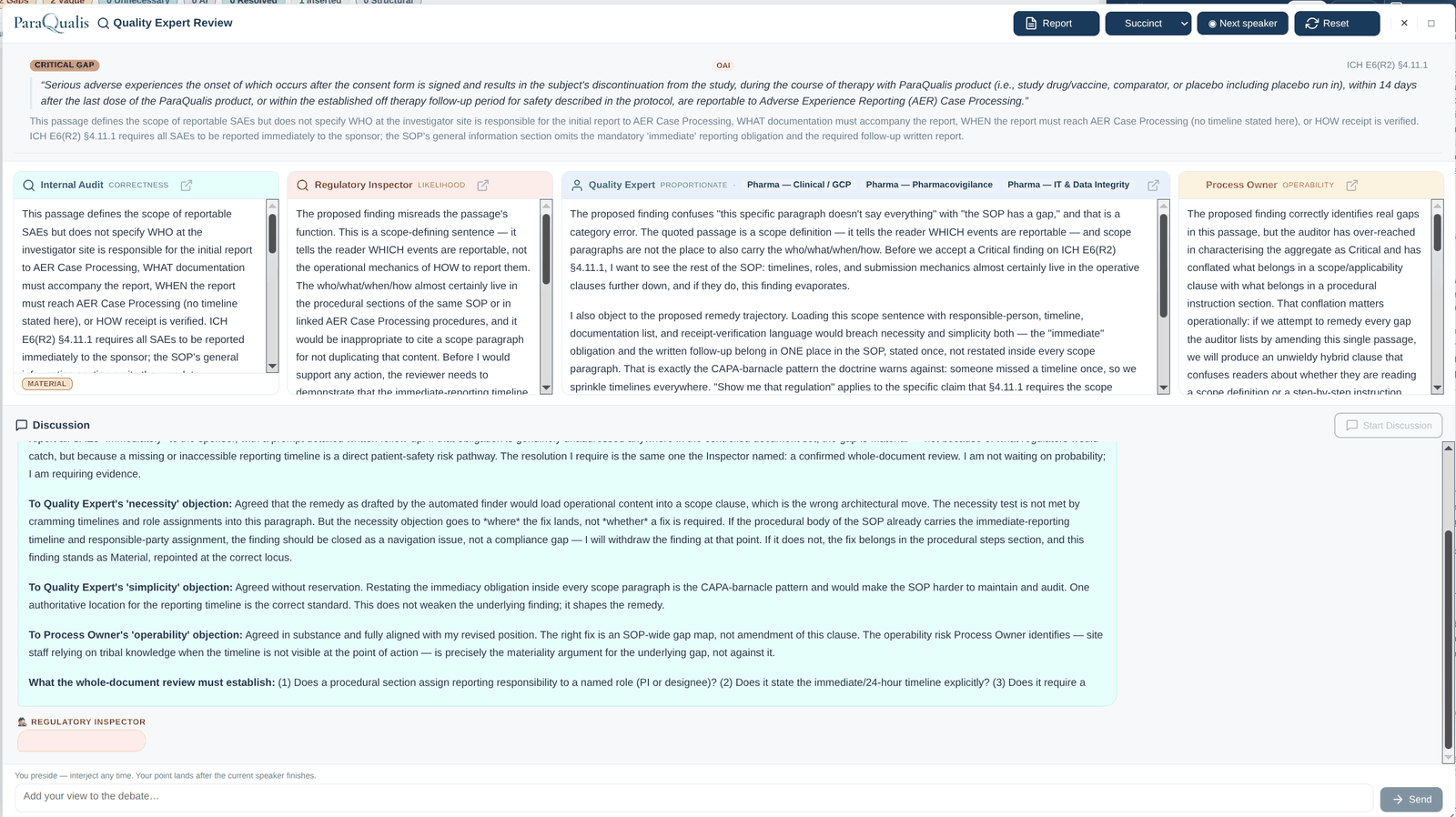
Before a finding reaches you, a panel argues it out. These five step forward in every debate:
Inspector
Interprets the applicable rules and flags where a procedure drifts from regulatory expectations.
Internal audit
Reads like an auditor: surfacing gaps, conflicts, and vague or unnecessary steps before an audit does.
Quality Lead
Ensures the debate considers your obligation to quality is met, without being overdone.
Process Owner
Asks whether this actually works in practice: can it be implemented the way your business runs today, and what needs to happen to make it stick.
Facilitator
Guards against AI drift by reviewing what the other agents produce, drives the panel toward a consensus-based recommendation, and breaks deadlock when they can't agree.
Review
Every document read in full against the applicable rules.
Identify
Gaps, conflicts, and drift surfaced as candidate findings.
Adjudicate
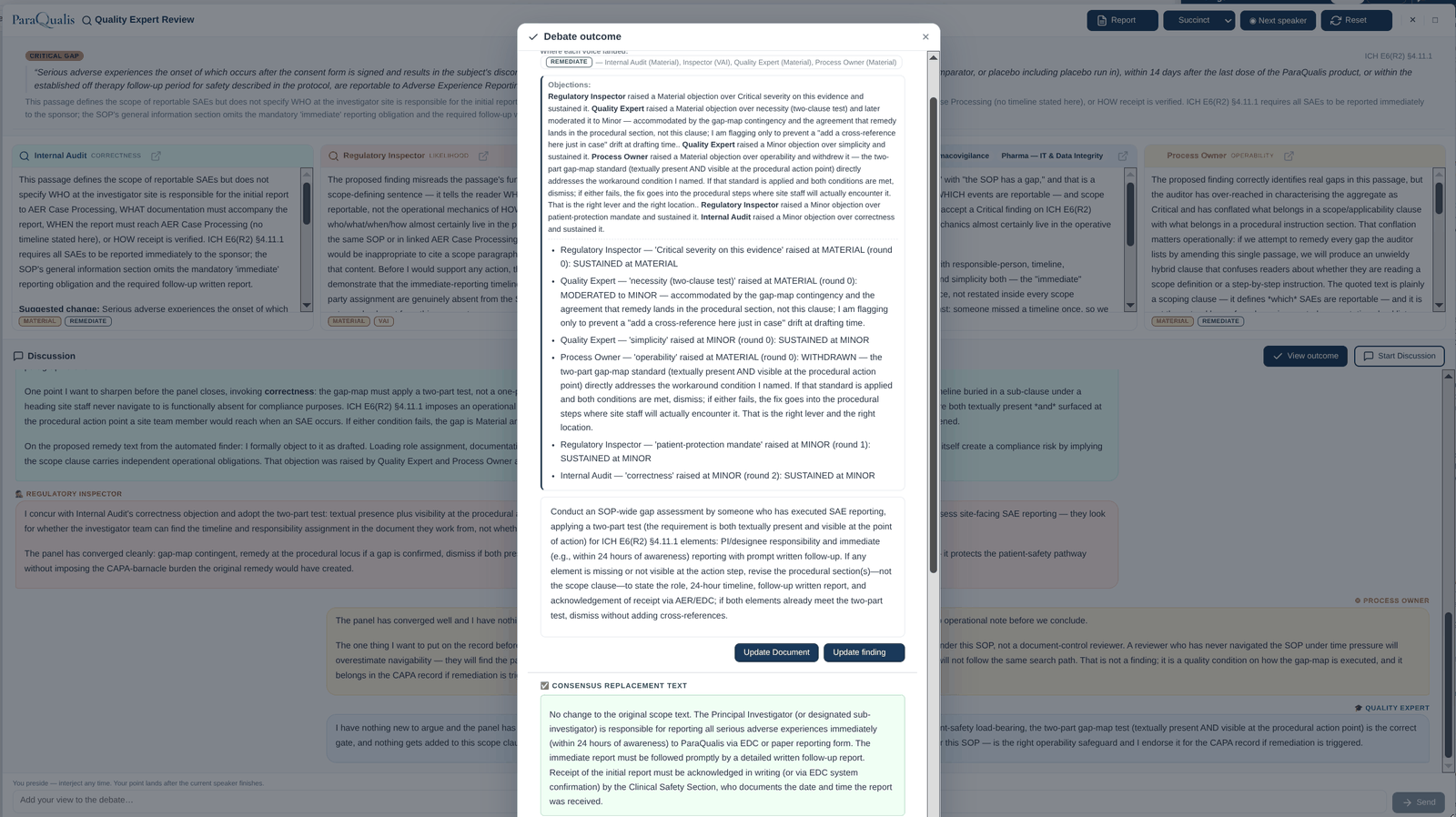
The panel argues each one out to a reasoned, risk-weighted verdict.
Update
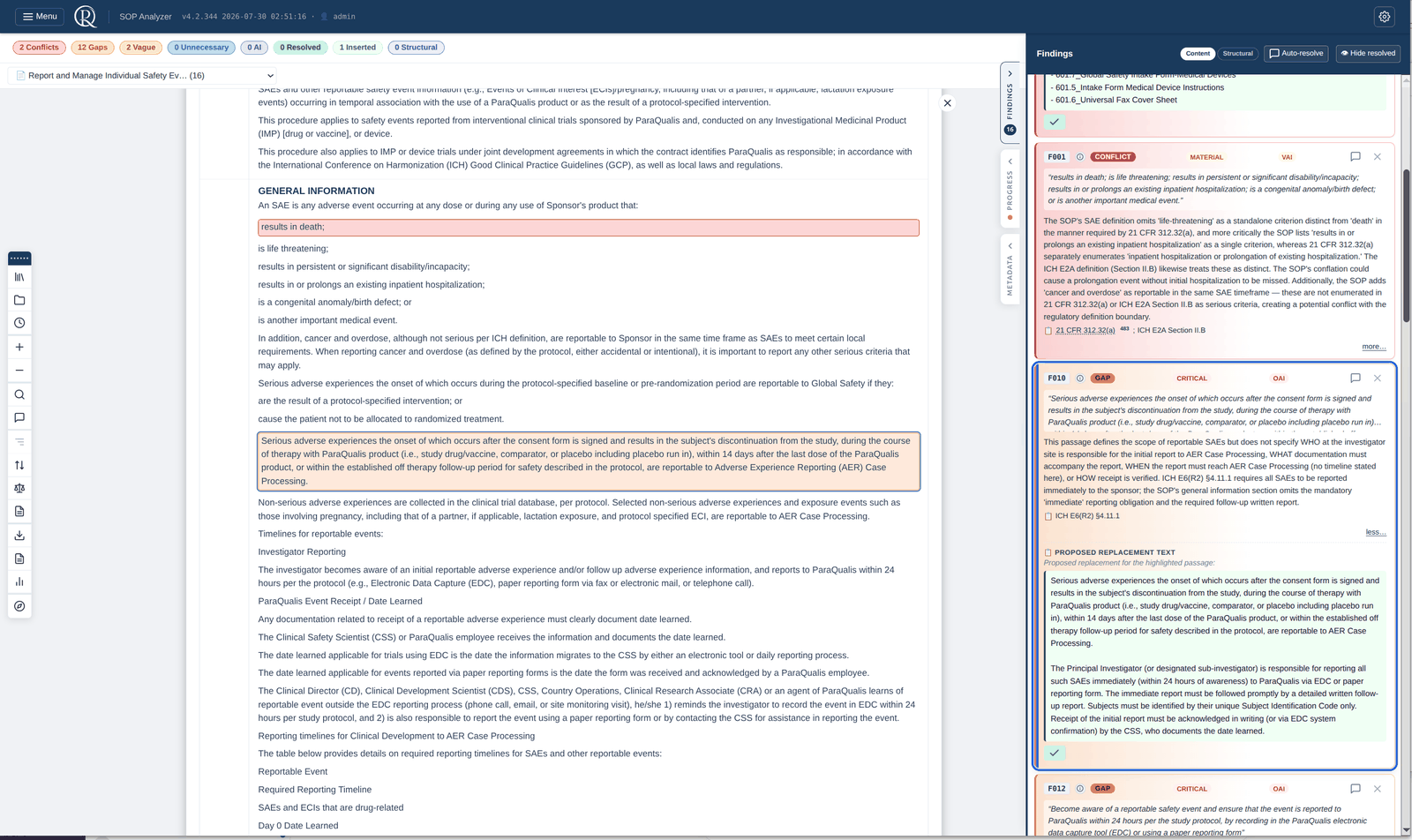
The consensus opinion is written back into the documentation itself, not left in a separate report.
Ask why a finding was raised, challenge it, or accept it. The agents explain their reasoning in plain language your team can act on. That's Converse.
Consensus in hours, not review cycles.
Replace the artisanal approach, where quality depends on who happened to review it and how thorough they were that week, with one consistent model applied the same way every time.
Faster agreement
What used to take rounds of review and back-and-forth to get everyone aligned now reaches a reasoned, defensible consensus in a fraction of the time.
One consistent model, not an art form
The same rigor, applied the same way, every time. Findings stop depending on which reviewer you happened to get.
Every market, every language
Check the same document against multiple regulatory frameworks (21 CFR, ICH, EU GMP, and others) and in multiple languages, without standing up a separate review process for each.
Every finding is grounded and defensible.
Each issue ties back to the exact line in your document and the exact rule it's tested against.
Anchored to the source
Every finding points to the exact paragraph and location in your SOP, not a vague, unlocatable summary.
Cited to the regulation
Each finding names the clause behind it (21 CFR, ICH, EU GMP) so you can check the reasoning, not just the verdict. Any regulator, multiple languages.
Ready for inspection
Findings, decisions, and the reasoning behind them are captured together and stay defensible long after the review.
Built for the regulated world.
Not a productivity add-on bolted onto quality. A system designed to stand up to an audit.
Part 11 by design
Immutable effective records, electronic signatures, and a per-organization audit trail: the electronic-records controls regulators expect.
Controlled documents, managed
A full draft-to-effective lifecycle, with stamped, versioned controlled copies minted automatically at release.
Validated software
Delivered with IQ/OQ/PQ validation coverage that is maintained alongside the product, not bolted on afterwards.
You can put it in front of a Head of Quality, and it survives the first hard question.
One model, every view. One platform, every domain.
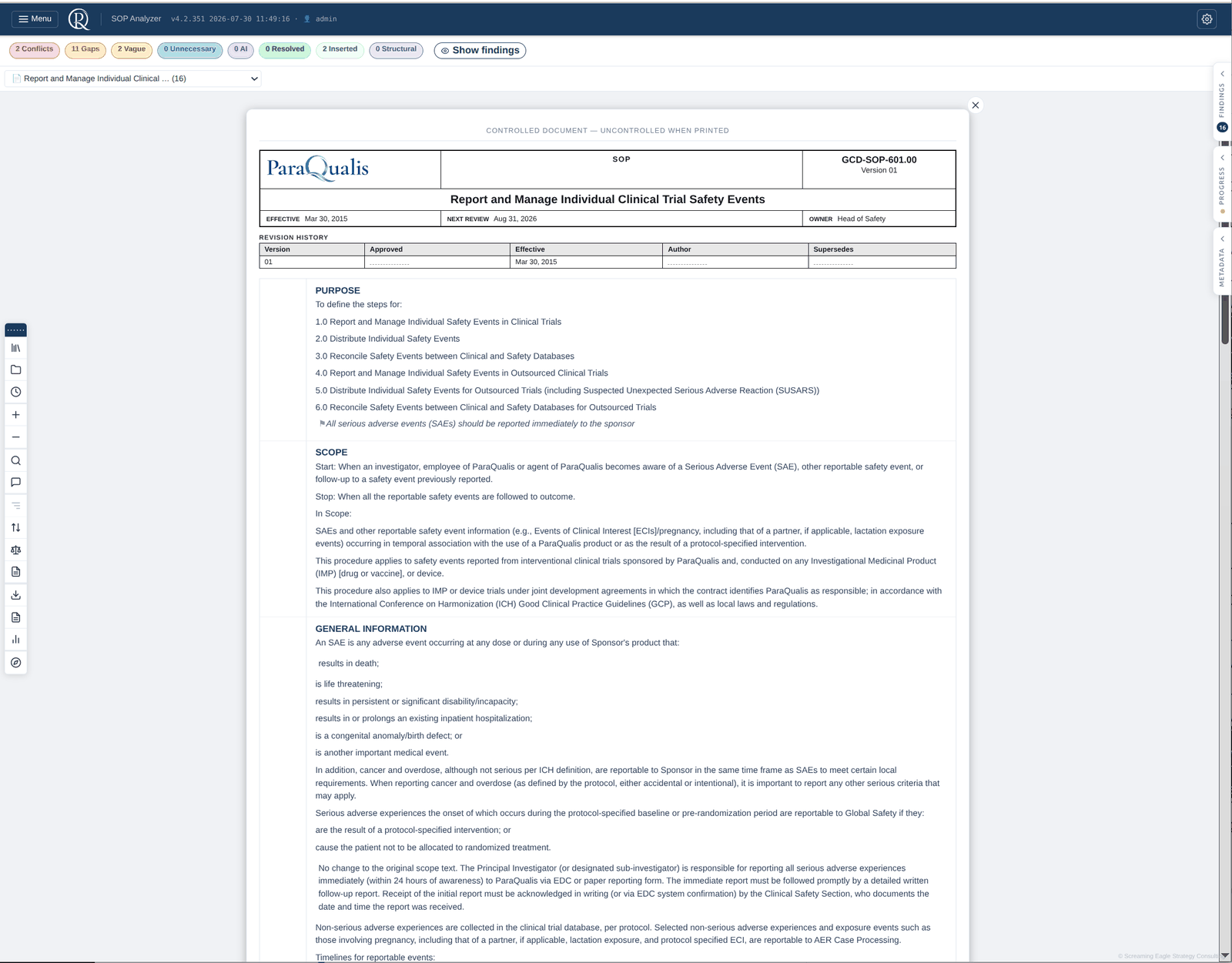
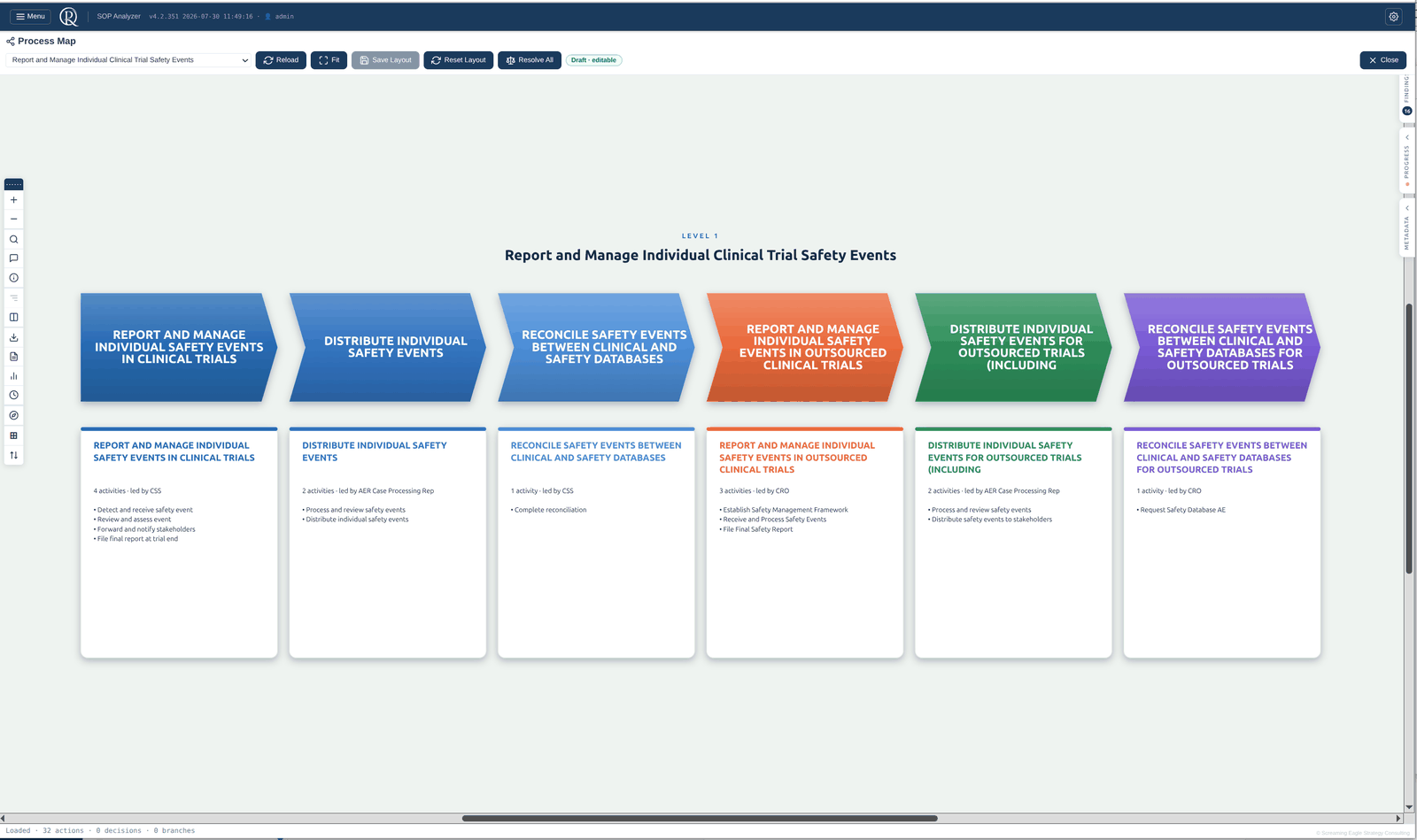
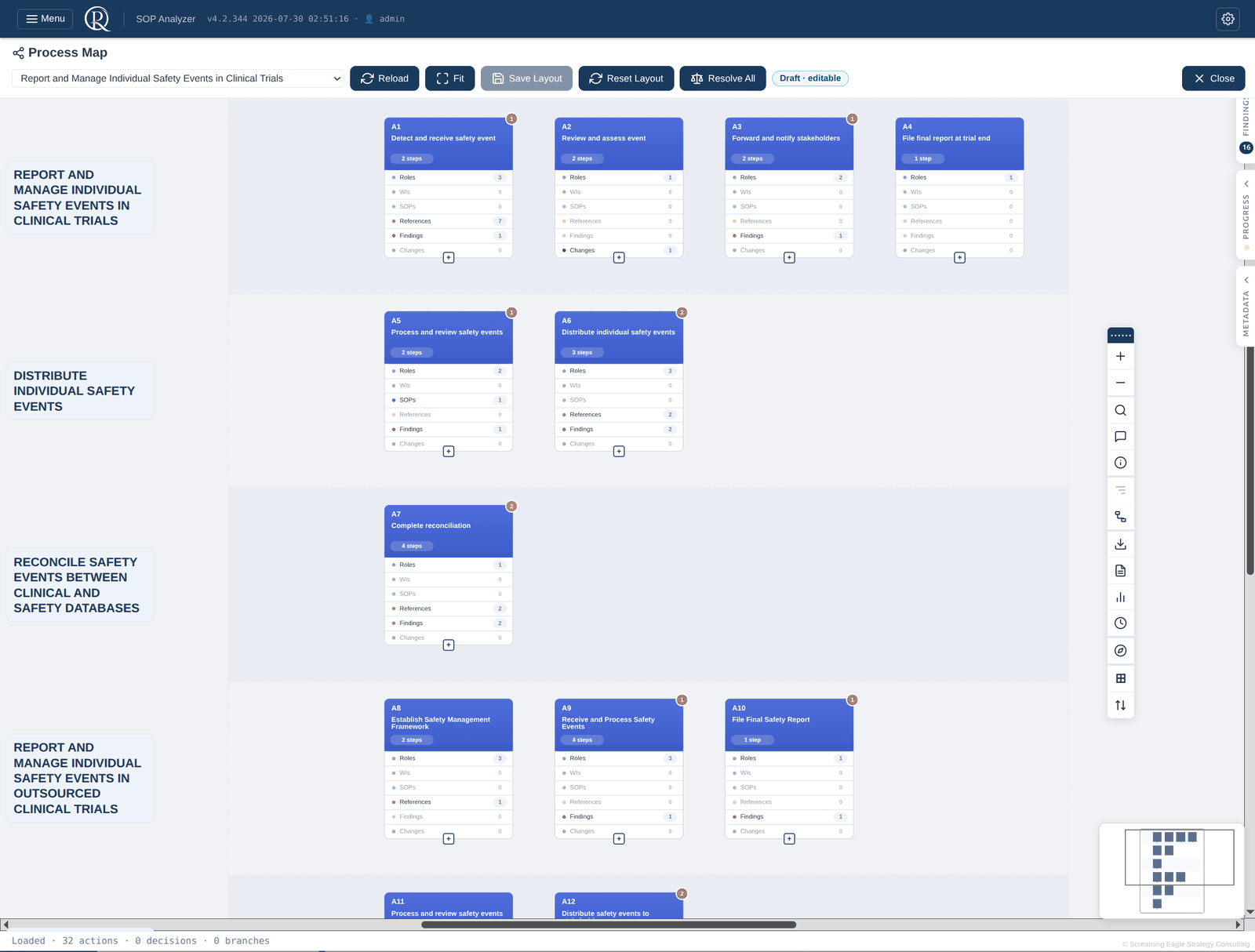
The same document, understood once as a structured object, then rendered as whichever view your team needs: the controlled document itself, a high-level process map, a detailed activity view, or full BPMN. See it, communicate it, and train on it however works for your team, with zero risk of the different versions drifting apart.
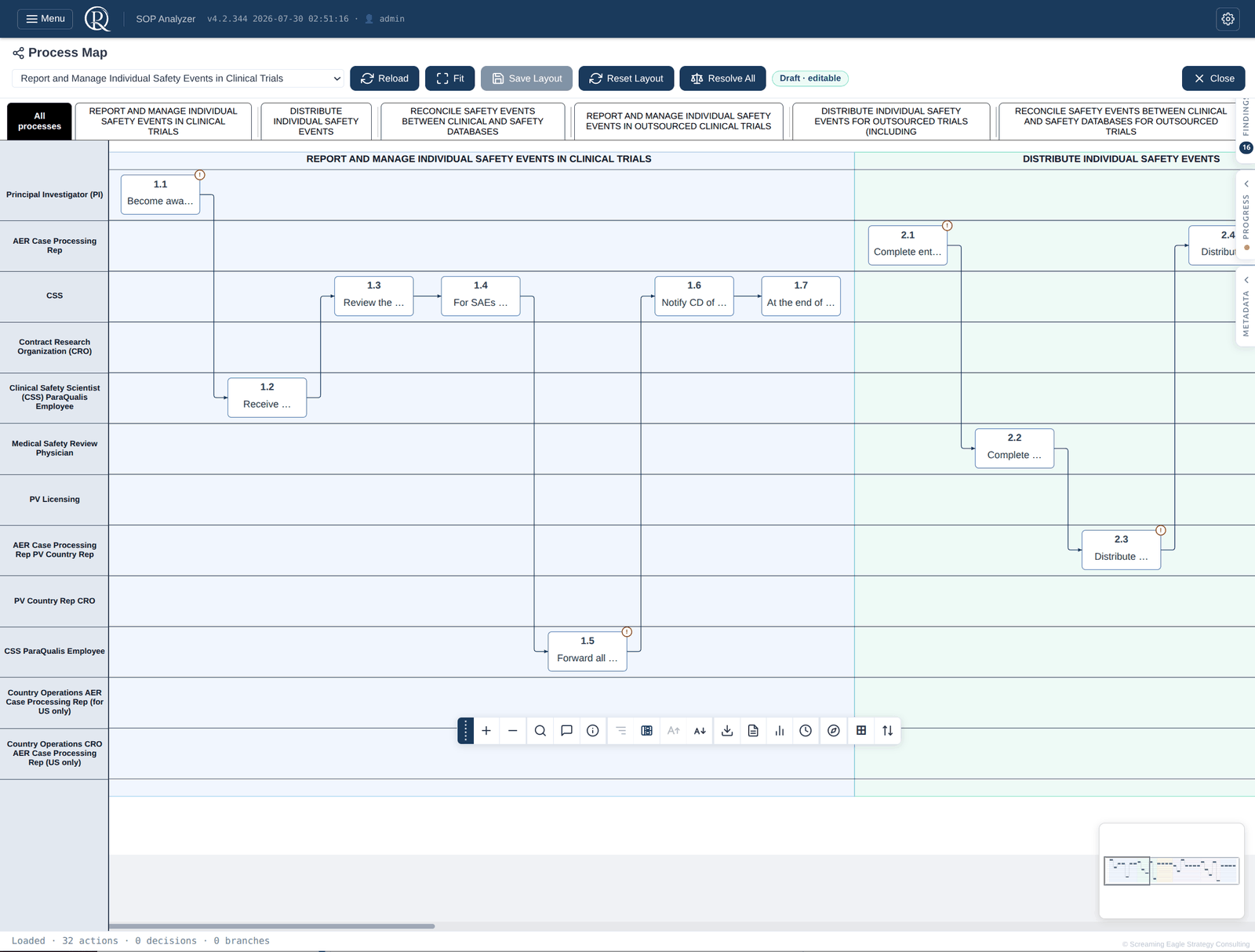
One source of truth
No duplicated or drifting copies. What you see in one view is the same record everywhere. Nothing to reconcile.
Four views, one object
The document, Level 1 and Level 2 process maps, and BPMN are all views of a single object model. Change it once and every view updates.
Multi-domain, no re-engineering
Pharma today; aviation and other regulated sectors next. A new domain is configuration: data, not code.
Your whole quality system, connected.
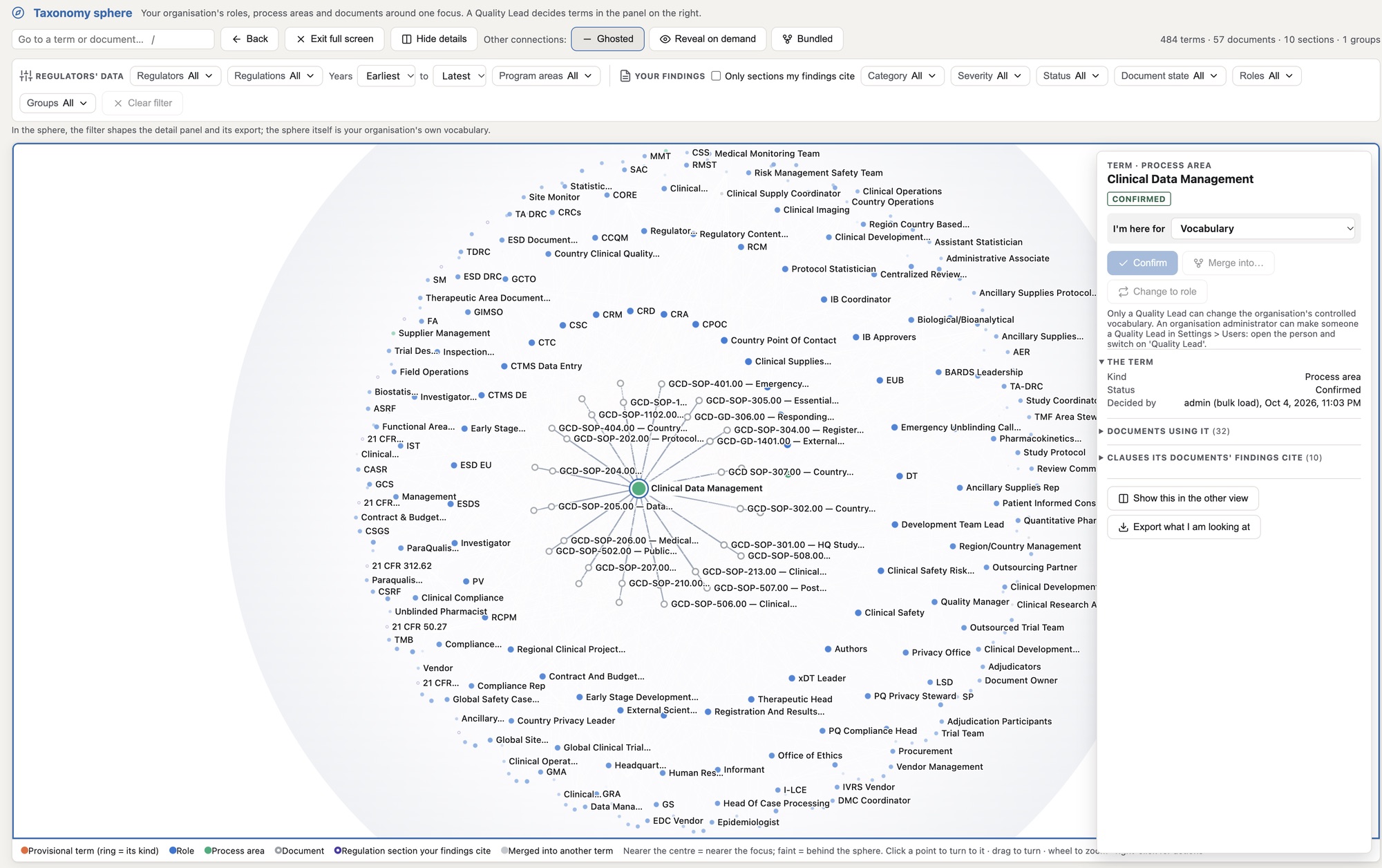
ParaQualis.ai builds a knowledge graph of your organization: every SOP, work instruction, role, regulation and finding, linked to everything it touches. Start anywhere and follow the connections wherever they lead.
Navigate from anywhere
Start from a process area, a role, a document or a regulation, and see everything connected to it, one click at a time.
Your own vocabulary
Roles, process areas and terms are drawn from your own documents, and a Quality Lead confirms or merges them into one controlled vocabulary.
Focused on what matters
Filter by regulator, regulation, year or program area, or by your own findings' category, severity and status, then export exactly what you're looking at.
Compliance-driven. Process-familiar. Built by the people who've lived it.
Every capability starts from the regulatory obligation, not a generic workflow tool with a compliance label stuck on afterward.
Compliance-driven, not compliance-adjacent
Regulatory obligation is the starting point for every capability, not a feature bolted onto a generic document manager after the fact.
Process-familiar
Built around how quality and regulatory teams actually work, by people who've sat through the audits and the remediation, not designed by people who've only ever seen a process diagram.
Next-generation, not incremental
AI-native from the ground up. The legacy platforms are optimizing yesterday's workflow; this leaves them in its digital wake.
Want to see it against your own documents?
A walkthrough takes 30 minutes and uses a real SOP of yours, not a canned demo.
Request a walkthrough